 FBR Updates
Every year, millions of salaried people in Pakistan stare at the same screen and ask the same question: "Where do I even start?"
This IRIS 2.0 salaried return guide answers that question in plain language. You will learn who must file, what documents to keep ready, how to complete your return on the FBR portal, and what to do if you are late. Most salaried filers finish the actual filing in under an hour once their papers are ready. The confusion usually comes from not knowing the process, not from the process being hard.
This is a pillar guide, so it links out to deeper articles on every sub-topic. Read it top to bottom, or jump to the section you need.
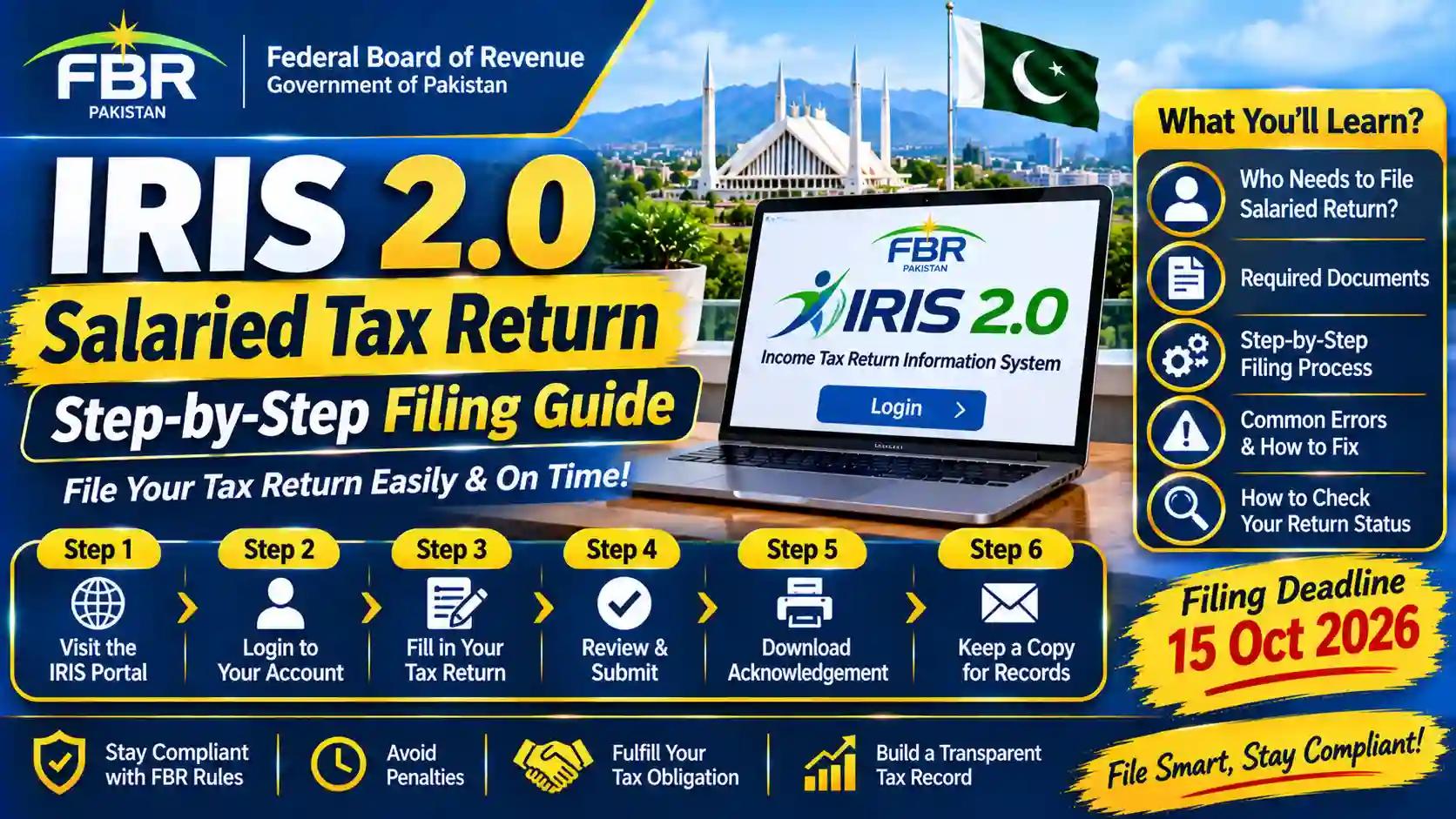
To file a salaried return on IRIS 2.0, log in at iris.fbr.gov.pk with your CNIC/NTN and password, open the income tax return section under Declaration, choose Tax Year 2026, and select the salaried return form, usually Form 114(I). Enter your salary and tax deducted by your employer, add credits and your wealth details, verify the computation, submit, and download the acknowledgement receipt.
What Is IRIS 2.0?
IRIS 2.0 is the upgraded online tax portal of the Federal Board of Revenue (FBR), available at iris.fbr.gov.pk. It is where individuals, salaried employees, freelancers, businesses and companies register, file returns, submit wealth statements and make e-payments.
Think of it as your digital tax office. Instead of visiting a Regional Tax Office (RTO) with files and photocopies, you do the same work from your phone or laptop.
How IRIS 2.0 is different from the old IRIS
The new version pulls many older, scattered tools into one dashboard. It also shows pre-filled data, such as employer-reported figures, so you do not start from a blank page. You are still responsible for checking every line before you submit.
If you want a feature-by-feature walkthrough, read our guide on the IRIS 2.0 FBR portal's new features and navigation. To understand how it differs from the earlier portal, see e.FBR vs IRIS tax portal in Pakistan. New to the portal in general? Start with what the FBR IRIS portal is.
FBR and IRIS: are they the same thing?
No. FBR is the government body that collects federal taxes. IRIS is the online system FBR uses to interact with taxpayers. FBR is the organization, IRIS is the tool.
Why Filing Your Salaried Return Matters in Pakistan
Many employees think, "My employer already deducts tax, so I'm done." That is only half true.
Your employer deducts tax from your salary under Section 149 and deposits it with FBR. But the return of income is your own declaration. Filing it is what places you on the Active Taxpayer List (ATL) and protects you from higher withholding rates.
Here is what filing gives you in practice:
- Lower withholding tax on banking transactions, property deals, vehicle registration and more.
- Eligibility to buy and sell property and vehicles at filer rates.
- Refund rights if more tax was deducted than you owed.
- Financial paper trail for visas, loans and credit cards.
- Peace of mind when FBR cross-checks your lifestyle against your declared income.
For a deeper comparison, read filer vs non-filer in Pakistan (2026) and our guide on how to become an active tax filer.
Who Must File a Salaried Return in 2026?
You are generally a "salaried individual" when most of your income, usually 75% or more of your taxable income, comes from employment.
You should file if any of these apply during the tax year:
- Your taxable income is above the tax-free threshold (currently Rs 600,000 a year for salaried individuals).
- You were on the Active Taxpayer List in the previous year.
- You hold an NTN and are required to stay compliant.
- You own property, a vehicle or other assets that fall under FBR's filing criteria.
- You earn extra income such as rent, freelance work or profit on savings.
Even if your tax liability is zero, filing is often smart. A "nil" return can still keep you on the ATL.
If you earn from more than one place, read multiple income sources and FBR tax rules. Salaried people who also earn online should check freelancer tax in Pakistan 2026. If you rent out a property, tax on rental income in Pakistan will help.
Note: FBR criteria change with each Finance Act. Always confirm the current rules on FBR's official website before you file.
Tax Year 2026: Key Dates and Deadline Status
Tax Year 2026 covers income earned from 1 July 2025 to 30 June 2026. In Pakistan, the tax year always runs from 1 July to 30 June, and you file after it ends.
Here is what happened this season:
- FBR opened Tax Year 2026 filing on 27 July 2026.
- The usual deadline for salaried individuals, other individuals and AOPs was 30 September 2026.
- FBR then extended it. According to ProPakistani's report, the date moved from 15 October to 31 October 2026.
Today is 16 November 2026, so that extended date has already passed. I could not confirm whether FBR has announced any later extension. Check the FBR website or IRIS announcements before you assume anything.
If you have not filed yet, do not panic and do not wait. Filing late is better than not filing at all. Our guide on late income tax returns and penalties in Pakistan (2026) explains your options, and why FBR extends tax return deadlines explains the pattern behind these extensions. For the full timeline, see the FBR income tax return deadline 2026 article.
Documents You Need Before You Log In
Most delays happen because people start filing and then go hunting for papers. Collect everything first. Here is a simple checklist:
- CNIC (valid and matching your NADRA record).
- NTN (if you do not have one, see how to get an NTN in Pakistan).
- Mobile number and email registered with FBR, since you need them for OTP.
- Salary certificate or 12 months of salary slips.
- Employer's tax deduction certificate showing tax withheld under Section 149.
- Bank statements and profit certificates (for savings income).
- Zakat and donation receipts, if you plan to claim them (see zakat deduction under Pakistan's income tax law).
- Education fee receipts if you may claim a tax credit (see education tax credit eligibility).
- Details of assets: property, vehicles, bank balances, investments, loans.
- Last year's return, if you filed one, for comparison.
Tip: Keep scanned copies in one folder on your phone. It saves a lot of stress if the portal logs you out halfway.
IRIS 2.0 Registration and Login
If you are a first-time filer, you must register before you can file.
Step 1: Register on IRIS 2.0
- Open iris.fbr.gov.pk.
- Choose the registration option for individuals.
- Enter your CNIC, mobile number and email.
- Verify using the OTP sent to you.
- Complete the profile and set a strong password.
Your NTN is typically your CNIC number once registration is complete.
Step 2: Log in
Use your CNIC or NTN, password and the OTP/captcha. Never share your password or OTP with anyone, including a tax consultant. FBR will never ask you for it.
Common login problems
Locked accounts, captcha failures and missing OTPs are the usual culprits. Our full troubleshooting guide, FBR IRIS login problems and solutions, covers the fixes. Also see the basic FBR IRIS login guide for Pakistan.
Step-by-Step: How to File a Salaried Return on IRIS 2.0
Menu names can change slightly after portal updates. The flow below matches how filers described the Tax Year 2026 process.
Step 1: Open the return section
After logging in, go to Declaration in the left menu, then choose the income tax return option (shown as Returns/Statements, Normal Return for an original return).
Step 2: Select the tax year
Choose Tax Year 2026. This is the one that covers 1 July 2025 to 30 June 2026.
Step 3: Pick the right form
If your profile shows you as salaried, IRIS usually suggests Form 114(I). Check that it matches your situation. If you also have significant business income, you may need a different form.
Step 4: Fill in your personal details
Check your name, CNIC, address, employer and contact details. Fix anything outdated.
Step 5: Enter your salary income
Fill in:
- Gross salary for the year.
- Allowances and perquisites (house rent, car, medical, utilities).
- Provident fund, gratuity or bonus, where applicable.
Match the totals with your employer's salary certificate. Mismatches are the number one trigger for later FBR queries.
Step 6: Enter tax already deducted
Add the withholding tax your employer deducted. This must match the tax deduction certificate. For other deductions such as bank profit or utility bills, see FBR withholding tax rates in Pakistan.
Step 7: Add deductions and tax credits
Claim only what you can prove:
- Zakat paid.
- Charitable donations.
- Education expenses (if eligible).
- Other approved credits.
Step 8: Add other income
Declare rental income, profit on debt, freelance income or foreign income if you have them. Hiding small side income is a classic mistake that leads to notices.
Step 9: Review the tax computation
IRIS calculates your tax liability. Compare it with a manual estimate. You can cross-check with ETTC's free salary income tax calculator or read how to calculate income tax on salary in Pakistan (2026).
Step 10: Complete the wealth statement
Most filers also submit a wealth statement showing assets and liabilities. Read our dedicated guide on wealth statement filing on IRIS for Tax Year 2026 before you fill it in.
Step 11: Pay any balance due
If your total tax is higher than what your employer deducted, generate a PSID and pay through your bank or e-payment channel. Keep the receipt.
Step 12: Submit and download the acknowledgement
Click submit, then download the acknowledgement or submission receipt. This is your legal proof of filing. Save it in your email and on your phone.
Real-world tip: Do not file at 9 pm in the last week of a deadline. The portal slows down when everyone files together. Early morning is usually smoother.
For a general walkthrough beyond salaried cases, see how to file an income tax return in Pakistan and our broader Pakistan tax return guide.
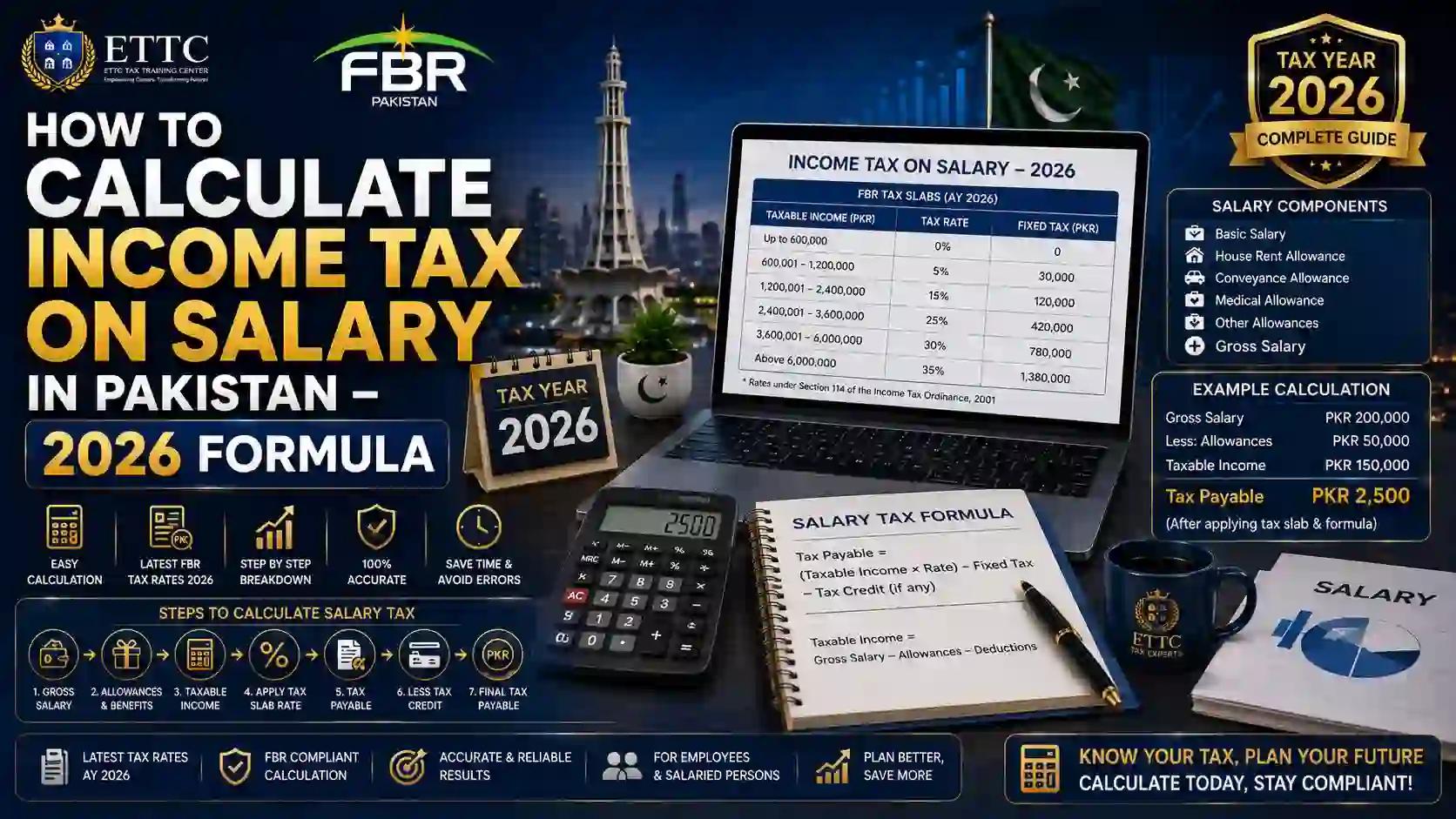
Salaried Income Tax Slabs for Tax Year 2026
Slabs decide how much tax you pay. For Tax Year 2026 (July 2025 to June 2026), they come from the Finance Act 2025. The salaried slabs are:
- Up to Rs 600,000: no tax.
- Rs 600,001 to Rs 1,200,000: 1% of the amount above Rs 600,000.
- Rs 1,200,001 to Rs 2,200,000: Rs 6,000 plus 11% of the amount above Rs 1,200,000.
- Rs 2,200,001 to Rs 3,200,000: Rs 116,000 plus 23% of the amount above Rs 2,200,000.
- Rs 3,200,001 to Rs 4,100,000: Rs 346,000 plus 30% of the amount above Rs 3,200,000.
- Above Rs 4,100,000: Rs 616,000 plus 35% of the amount above Rs 4,100,000.
A surcharge may also apply to very high incomes. Always verify against the current law, and check our updated explainer on income tax slabs for salaried persons in Pakistan.
Worked example 1: a mid-level employee
Ali earns Rs 150,000 a month, so Rs 1,800,000 a year.
- He falls in the Rs 1.2M to 2.2M slab.
- Base tax: Rs 6,000.
- Extra: 11% of Rs 600,000 (the amount above Rs 1.2M) = Rs 66,000.
- Total annual tax: about Rs 72,000, or roughly Rs 6,000 a month.
Worked example 2: a senior manager
Sana earns Rs 375,000 a month, so Rs 4,500,000 a year.
- She falls in the "above Rs 4.1M" slab.
- Base tax: Rs 616,000.
- Extra: 35% of Rs 400,000 = Rs 140,000.
- Total annual tax: about Rs 756,000.
These examples are illustrative and ignore credits and deductions. Your actual number may be lower. Rules for the next tax year changed again with the new budget, so also read Budget 2026-27: Pakistan tax changes.
Common IRIS 2.0 Errors and How to Fix Them
Even prepared filers hit snags. Here are the most common ones:
- Portal slow or not loading. Try off-peak hours, clear your browser cache, or switch browser.
- OTP not arriving. Check that your mobile number is active and updated in your profile.
- Captcha errors. Refresh and retype slowly. Avoid autofill.
- Salary mismatch with employer data. Ask HR to correct the data or re-upload their statement.
- Form not suggested. Your profile may not be flagged as salaried. Update your profile or choose the correct form manually.
- Calculation looks wrong. Recheck slab, credits and withholding entries.
During Tax Year 2026, many taxpayers reported technical bugs in the new return form. FBR kept releasing fixes through the season. If something looks broken, save your draft and try again later rather than submitting a questionable return. Read our IRIS 2.0 survival guide for the 2026 tax season for more fixes.
Late Filing, Penalties and Getting Back on the ATL
If you missed the deadline, the sooner you file the better. Late filing can bring:
- A penalty under Section 182, which can build up with each day of default.
- Removal from the Active Taxpayer List, which means higher withholding rates.
- A late-filing fee to re-enter the ATL, depending on the rules in force.
Once your return is accepted, check whether you appear on the list again. Our guide on how to check the FBR Active Taxpayer List (ATL) shows you how.
If you need more time before the due date next year, an individual can apply to the Commissioner for an extension under Section 119. Apply before the deadline, not after.
For the full picture of penalties, see late income tax return in Pakistan 2026 penalty.
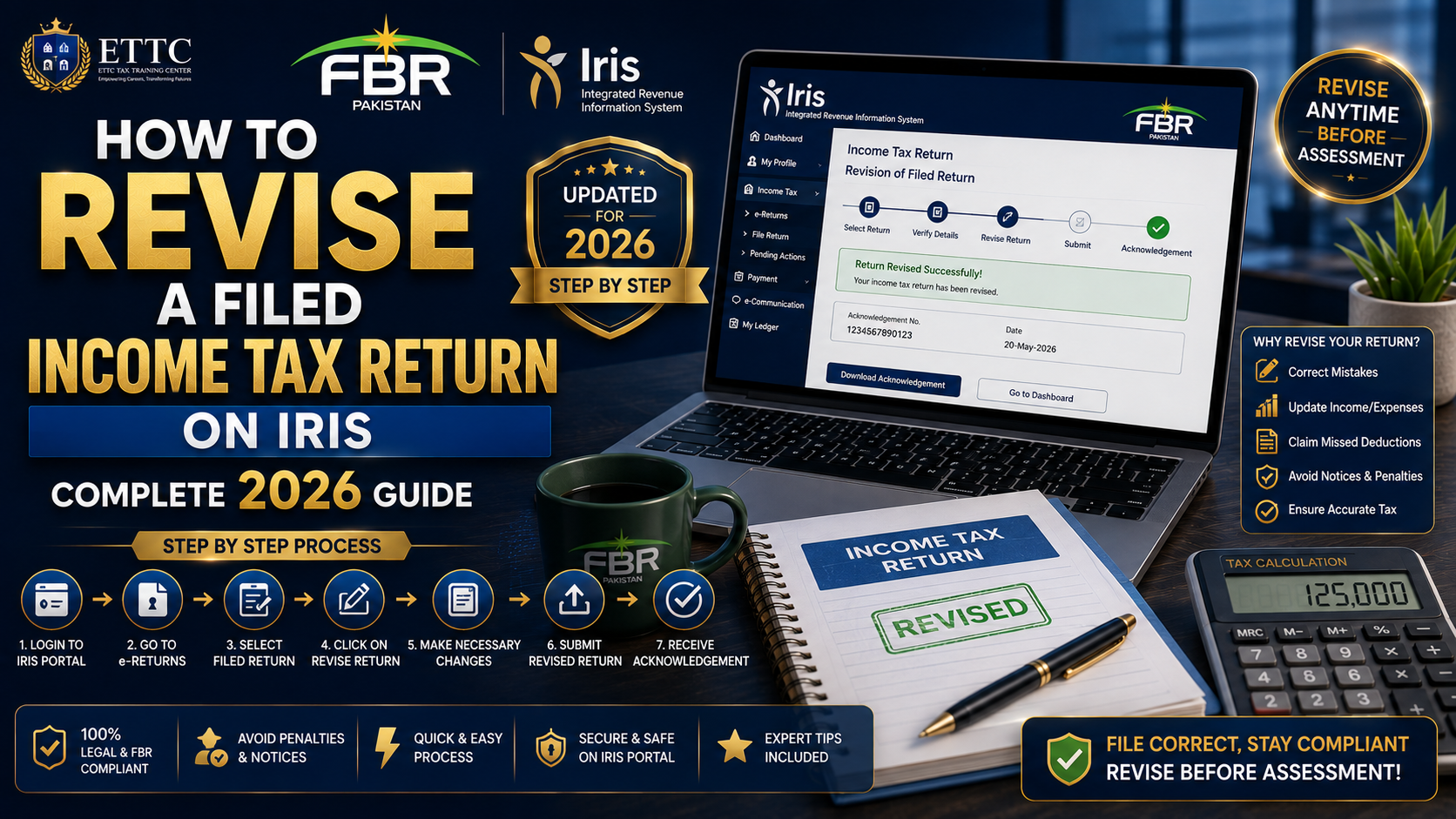
Made a Mistake? How to Revise Your Return
Everyone makes errors. You may have forgotten an allowance, entered the wrong tax figure or missed a credit.
You can generally file a revised return within the time allowed by law, subject to FBR conditions. Follow our practical guide: how to revise an income tax return on IRIS FBR.
If you paid too much tax, you may also be entitled to a refund. See how to claim a tax refund from FBR.
Filing a Salaried Return From Different Cities
The online process is identical everywhere in Pakistan, whether you live in Islamabad, Karachi, Lahore, Multan, Rawalpindi, Faisalabad, Peshawar, Quetta or Wah Cantt. What changes is the local help available.
Islamabad and Rawalpindi
Many federal employees and private-sector professionals file here. Walk-in help is easy to find near the Blue Area and Rawalpindi's Saddar, and the Islamabad RTO deals with local tax offices. If you want to learn the process properly, see our FBR income tax training in Islamabad.
Karachi
Karachi has a large population of salaried filers in banking, telecom and corporate jobs. Large employers usually send tax certificates in bulk, so ask HR early. Explore FBR income tax training in Karachi.
Lahore
Professionals in Gulberg, DHA, Johar Town and Model Town often combine salary with rental or freelance income. Review the multi-income rules first. Learn more about our FBR income tax training in Lahore.
Multan and other cities
You do not need to visit an office to file. Everything happens online. If you want guidance, reach out through the ETTC contact page and ask about online options.
Local tip: Whichever city you live in, avoid unverified "agents" who ask for your IRIS password. Use a registered consultant, or learn to file yourself.
Overseas Pakistanis and Special Situations
Salaried Pakistanis working abroad have their own rules, especially around residency and foreign income. Do not assume you are exempt. Read Pakistani overseas workers' tax: FBR NRP rules 2026 before filing.
If you are a freelancer, a business owner with a salary, or an HR professional handling payroll for others, see payroll tax in Pakistan: 2026 HR and finance guide.
How to Avoid FBR Notices After Filing
A clean return rarely attracts questions. Follow these habits:
- Match every figure to a document.
- Declare all income sources, even small ones.
- Keep your wealth statement consistent year to year.
- Never claim credits without receipts.
- Save the acknowledgement and your working papers for at least six years.
If you do receive a notice, do not ignore it. Read FBR tax notices explained and understand your rights. For a deeper view of how FBR picks cases, see FBR tax audit process in Pakistan 2026.
Learn Taxation as a Skill: Scope, Salary and Career Growth
Filing your own return is a useful life skill. For many people, it becomes a career.
Why taxation skills are in demand in Pakistan
FBR is pushing digitization, risk-based audits and tighter compliance. That means individuals, SMEs and companies all need help they can trust. People who understand IRIS, withholding rules and return preparation are valuable.
Skills you can build
- Preparing and reviewing returns on IRIS 2.0.
- Handling NTN, ATL and wealth statements.
- Computing salary tax and withholding.
- Responding to FBR notices.
- Advising on tax planning.
Job scope and earning potential
Typical routes include tax consultant, tax advisor, in-house tax officer, payroll specialist, or running your own consultancy. See how to become a tax consultant in Pakistan, tax consultant salary in Pakistan and how to start a tax consultancy firm in Pakistan.
Not sure whether you need a consultant or a lawyer for a dispute? Read tax consultant vs tax lawyer in Pakistan.
Future career opportunities
Technology is changing the field. FBR is exploring automation and AI in tax filing, so practical IRIS skills plus judgment will matter more. Read FBR and artificial intelligence in tax filing to see where this is heading. Professionals can also branch into international tax, such as the UK, USA, UAE and Saudi systems, through ETTC's course catalog.
Why Choose ETTC
If you want to move from "I filed once" to "I can do this confidently," structured training helps. Here is why learners look at why choose ETTC:
- Practical focus. Training around real IRIS workflows, not just theory.
- Pakistan-first content. FBR income tax, sales tax, withholding tax and compliance.
- Experienced mentors. Meet the ETTC mentors and see their backgrounds.
- City and online options. Programs in Islamabad, Karachi and Lahore, with online learning for other cities.
- Free tools. Calculators for salary, rental income, withholding tax and more.
Comparing institutes? Our guides on the best tax institute in Islamabad and best tax courses in Islamabad will help you decide with open eyes.
How to Learn: Free and Paid Resources
Free resources
- The official FBR website for notices, forms and announcements.
- The Income Tax Ordinance, 2001 on Pakistan Code for the law itself.
- ETTC's free tax calculators.
- Blog guides, such as 10 benefits of learning taxation in Pakistan.
Paid, structured learning
A guided course gives you hands-on practice, feedback and a clear learning path. If you want to go deeper than self-study, explore advanced taxation courses at Elite Tax Training Centre (ETTC). Not sure whether to learn online or in a classroom? Read online vs physical tax courses in Pakistan.
FAQs: IRIS 2.0 Salaried Return
1. What is IRIS 2.0?
IRIS 2.0 is FBR's upgraded online portal at iris.fbr.gov.pk. You use it to register, file income tax returns, submit wealth statements and pay tax online.
2. Is IRIS 2.0 mandatory for all taxpayers?
Yes. It is the active version of the FBR portal, so salaried individuals, freelancers and businesses all file through it.
3. Which form should a salaried person use?
Salaried individuals generally use Form 114(I), which IRIS often suggests automatically. If you also run a business, check whether you need a different form.
4. Can I file my own return without a tax consultant?
Yes. If your income is mostly salary and your documents are ready, you can file yourself. Consider a professional if you have rental income, foreign income or multiple sources.
5. How long does it take to file?
With documents ready, many salaried filers finish in 30 to 60 minutes. Your first time may take longer.
6. What documents do I need?
Keep your CNIC, NTN, salary certificate, tax deduction certificate, bank statements, zakat or donation receipts and asset details ready.
7. Do salaried persons need to file a wealth statement?
Most filers submit one alongside the return. Follow the current FBR requirement and our wealth statement guide.
8. What happens if I miss the deadline?
You may face a penalty, removal from the Active Taxpayer List and higher withholding rates. File as soon as possible and read about late return penalties.
9. Can I file a revised return?
Generally yes, within the time and conditions set by law. See how to revise your income tax return.
10. How do I get back on the Active Taxpayer List?
File your overdue return, pay any required amount, then check your status. Follow our ATL checking guide.
Conclusion
Filing a salaried return on IRIS 2.0 is much simpler once you break it into small steps: gather documents, log in, choose the right form, enter income and tax deducted, claim only what you can prove, and download your acknowledgement. Do it once properly, and next year becomes far easier.
If you want to go beyond filing your own return and build real tax skills, a structured course can shorten the learning curve a lot.
Ready for the next step? Book a seat at the Advance Taxation Course offered by Elite Tax Training Centre (ETTC), or contact the ETTC team to ask which program fits your goals.
Written by
ETTC Team
Expert instructor at ETTC – Elite Tax Training Centre, helping professionals master practical taxation for global careers.