 UK Tax
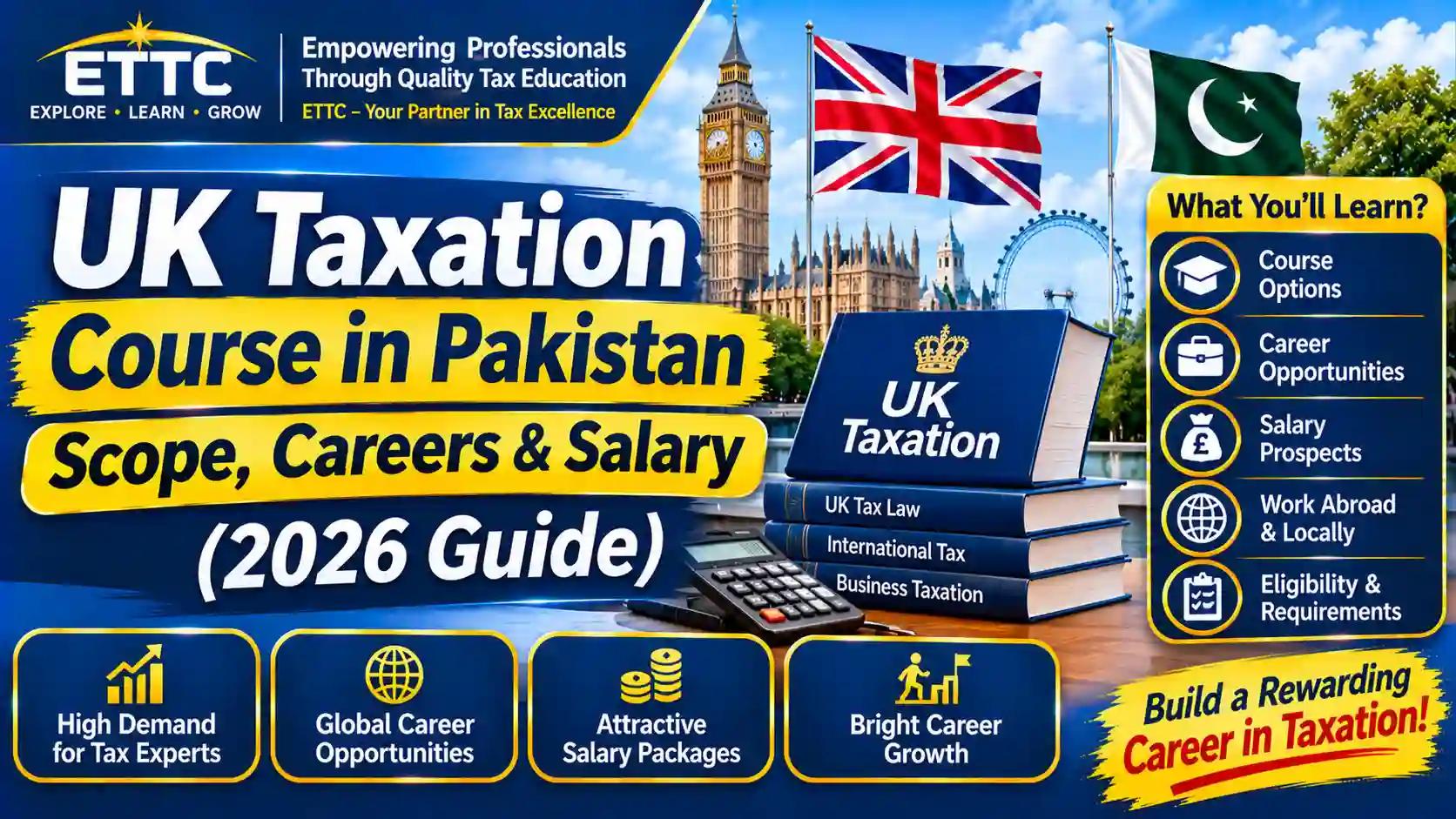
A UK taxation course in Pakistan teaches you how the British tax system works, including Income Tax, PAYE, National Insurance, VAT, Corporation Tax and Self Assessment under HMRC rules. It prepares Pakistani accountants, graduates and freelancers for remote UK tax jobs, outsourcing roles and recognised qualifications such as ACCA, ATT and CTA.
Thousands of UK accounting firms now send their tax work to Pakistan every year. Self Assessment returns, VAT filings, payroll runs and year-end accounts are prepared in offices in Lahore, Karachi and Islamabad, and then reviewed and submitted in London, Manchester or Birmingham.
The difficulty is that most Pakistani commerce graduates learn FBR rules, not HMRC rules. That skills gap is the reason a UK taxation course in Pakistan has become one of the most practical career moves for accountants in 2026.
This guide covers what you will learn, what the course costs, the jobs and salaries it can lead to, and how to choose between ACCA, ATT and CTA. It also explains how to start, whether you live in Islamabad, Karachi, Lahore, Multan or a smaller city with nothing more than a laptop and a good internet connection.
What Is a UK Taxation Course?
A UK taxation course is structured training in the tax laws administered by HMRC (His Majesty's Revenue and Customs), the UK's tax authority. It teaches you to calculate, prepare and file tax returns for individuals, sole traders, partnerships and limited companies in the UK.
A good course covers both theory and practice. You learn the rules, and you also learn to apply them in the software UK firms actually use.
Core topics in a UK taxation course syllabus
A well-designed UK taxation course syllabus usually covers:
- The UK tax year and administration: The tax year runs from 6 April to 5 April. You learn about tax codes, deadlines, penalties and HMRC online services.
- Income Tax and personal allowances: Tax bands, the personal allowance, reliefs, and how employment, rental, savings and dividend income are taxed.
- PAYE and National Insurance: How employers deduct tax at source, how payroll works, and the different classes of National Insurance contributions.
- Self Assessment tax returns: Preparing SA100 returns for sole traders, landlords, company directors and people with more than one source of income.
- Corporation Tax (CT600): Calculating taxable profits, capital allowances and filing company tax returns.
- Value Added Tax (VAT): Registration, VAT schemes, quarterly VAT returns and Making Tax Digital compliance.
- Capital Gains Tax (CGT) and Inheritance Tax (IHT): Gains on property and shares, reliefs, and estate planning basics.
- Construction Industry Scheme (CIS): The special deduction scheme for subcontractors in the construction sector, which is very common in outsourced work.
- International aspects: UK residency and domicile rules, non-resident tax, and double taxation agreements, including the UK–Pakistan treaty.
- Software training: Practical work in tools such as Xero, QuickBooks, Sage, FreeAgent, TaxCalc, IRIS and VT Transaction+.
To see how a structured programme organises these modules, review the UK Tax Course at ETTC.
What are the types of UK taxes?
The main UK taxes fall into two groups:
- Direct taxes: Income Tax, National Insurance, Corporation Tax, Capital Gains Tax and Inheritance Tax
- Indirect taxes: VAT, Stamp Duty Land Tax, and excise duties
For current rates and bands, the official HMRC Income Tax rates page on GOV.UK is the most reliable source and is updated every tax year.
Why Study UK Taxation in Pakistan?
Pakistan has a large pool of commerce graduates. Many of them compete for a limited number of local jobs. UK taxation lets them sell their skills to a much larger market, often while staying at home.
1. Outsourcing demand is real and growing
UK accounting practices face rising wage costs and a shortage of qualified staff. Many now use offshore teams for bookkeeping, payroll and tax preparation. Pakistan has three advantages here: widespread English, a similar accounting education base (many students already study ACCA), and a working-day overlap with UK office hours.
2. Making Tax Digital is creating new work
HMRC's Making Tax Digital (MTD) programme requires businesses and landlords to keep digital records and file through compatible software. MTD for VAT already applies to all VAT-registered businesses. MTD for Income Tax began in April 2026 for sole traders and landlords with qualifying income above £50,000, and it will extend to lower income thresholds in later years.
That means hundreds of thousands of extra quarterly digital submissions. UK firms need trained people to process them, and many of those people will work remotely.
3. You earn in pounds and spend in rupees
A Pakistani accountant serving UK clients remotely or as a freelancer can earn far more than a typical local salary for similar hours. The exchange rate is what turns a modest UK fee into a strong income in Pakistan.
4. It builds a bridge to working abroad
If you plan to move to the UK on a Skilled Worker visa, arriving with practical HMRC knowledge and software experience makes you far more employable than a candidate who only knows FBR procedures.
Difference between the Pakistani tax system and the UK tax system
Understanding this difference is often the first "aha" moment for students:
FBR vs HMRC, at a glance
- Tax year: Pakistan runs 1 July to 30 June. The UK runs 6 April to 5 April.
- Collection method: Pakistan relies heavily on withholding taxes at many transaction points. The UK relies on PAYE for employees and Self Assessment for everyone else.
- Indirect tax: Pakistan has federal sales tax plus provincial sales tax on services. The UK has a single national VAT, currently 20% at the standard rate.
- Digital filing: Pakistan uses the IRIS portal. The UK uses HMRC online services and MTD-compatible software.
- Professional practice: UK tax work is heavily software-driven and review-based, which suits remote teams.
If you already know Pakistani tax, your knowledge is still valuable. You understand concepts like withholding, filer status and tax computation. ETTC's FBR Income Tax course and UK course complement each other well for anyone building a dual-market career.
Who Can Enroll in a UK Taxation Course?
Almost anyone with a commerce or finance background can start. The most common learners include:
- Fresh graduates with B.Com, BBA or M.Com who want a job-ready skill
- ACCA students and affiliates who have passed or plan to take TX-UK
- CA and CMA students from ICAP and ICMAP looking for international exposure
- MBA (Finance) holders who want to move into tax
- Working accountants in Pakistani firms who want to switch to UK outsourcing
- Freelancers on Upwork, Fiverr or LinkedIn who want to serve UK clients
- Students planning to move to the UK for study or work
Do I need ACCA to study UK taxation?
No. You do not need ACCA to take a practical UK taxation course. A basic understanding of accounting (debits, credits, financial statements) is enough. ACCA helps, but many successful UK tax preparers in Pakistan started with a B.Com and a focused practical course.
If you are an ACCA student, this guide on taxation courses for CA and ACCA students explains how practical training fits around your exams.
What are the prerequisites for a UK tax course?
For a practical certificate course, you typically need:
- Intermediate or graduate-level education, preferably in commerce
- Basic accounting knowledge
- Working English (reading legislation and writing client emails)
- Basic Excel skills
- A laptop and a stable internet connection for online learning
Key Skills, Tools and Benefits You Gain
A UK taxation course is not only about memorising rates. Employers want people who can produce accurate work quickly in real software.
Technical skills
- Preparing Self Assessment tax returns for sole traders, landlords and directors
- Computing Corporation Tax and preparing CT600 returns
- Preparing and filing VAT returns under MTD
- Running payroll, calculating PAYE and National Insurance, and handling RTI submissions
- Handling CIS deductions and monthly returns
- Basic tax planning for allowances, reliefs and dividend vs salary decisions
Software skills
UK firms hire for software as much as for tax knowledge. The most requested tools are:
- Xero and QuickBooks for cloud bookkeeping
- Sage for bookkeeping and payroll
- FreeAgent for small businesses and freelancers
- TaxCalc, IRIS and VT Transaction+ for tax returns and year-end accounts
Soft skills
- Writing clear, professional emails to UK clients
- Working to strict HMRC deadlines
- Understanding UK business culture and client expectations
- Attention to detail during reviews
Benefits at a glance
- Access to the global outsourcing market
- Remote work options
- Higher earning potential than many purely local roles
- A clear path towards professional qualifications such as ATT and CTA
- Freelance and business opportunities
UK Taxation Course Duration, Fee and Learning Formats
How long does a UK taxation course take?
It depends on the depth of study:
- Short practical certificate: About 6 to 12 weeks, focusing on Self Assessment, VAT and software
- Comprehensive diploma: About 3 to 6 months, covering personal tax, business tax, payroll and VAT
- ACCA TX-UK: Usually one exam session of preparation, about 3 to 6 months
- ATT qualification: Usually 18 months to 3 years
- CTA qualification: Usually 2 to 4 years, often after ATT or ACCA
What is the fee for a UK taxation course in Pakistan?
The UK taxation course fee in Pakistan varies widely by institute, format and depth. Short practical certificates generally cost far less than professional qualifications. Online batches are often cheaper than classroom training. ATT and CTA involve UK-based exam and membership fees paid in pounds, so they cost considerably more overall.
Practical tip: Compare courses on value, not just price. Ask each institute:
- Is software training included?
- Will I work on real or realistic case studies?
- Are classes live, or only recorded?
- Do I get tutor support after class?
- Is there any internship or job assistance?
For ETTC's current fee and batch schedule, check the UK Tax Course page or contact the admissions team.
Online vs classroom UK tax course
Both formats work. The right one depends on your schedule:
- Live online classes suit working professionals and students outside major cities.
- Recorded lectures and self-paced LMS learning suit people with unpredictable hours.
- Classroom training suits learners who prefer face-to-face interaction and peer discussion.
- Blended learning combines live sessions, recordings, mock exams and practical assignments.
Many institutes now offer weekend and evening batches for people with full-time jobs. For a deeper comparison, read online vs physical tax courses in Pakistan.
Is a UK taxation course available online in Pakistan?
Yes. Most UK taxation courses in Pakistan are available online through live classes, recorded lectures and learning dashboards. Students in Multan, Faisalabad, Peshawar, Quetta or Sukkur can study the same syllabus as students in Lahore or Karachi.
ACCA vs CTA vs ATT: Which UK Tax Qualification Is Right for You?
This is one of the most common questions Pakistani students ask. Here is a simple breakdown.
ACCA (Association of Chartered Certified Accountants)
A broad accounting qualification. Tax is covered in TX-UK (Taxation) and the optional ATX-UK (Advanced Taxation). ACCA is widely available in Pakistan and gives a strong all-round foundation. Best for: students who want a full accounting career with tax as one strength.
ATT (Association of Taxation Technicians)
A specialist, technician-level tax qualification focused on practical compliance work. Best for: people who want to prepare returns and work in tax compliance roles quickly.
CTA (Chartered Tax Adviser)
Awarded by the CIOT (Chartered Institute of Taxation), CTA is widely seen as the leading UK tax qualification. It is demanding and advisory-focused. Best for: those aiming for senior tax adviser, tax manager or Big Four tax roles.
Which is better: ACCA, CTA or ATT?
There is no single "best." It depends on your goal:
- Want a quick, job-ready skill? Start with a practical UK taxation course.
- Want a broad, globally recognised accounting qualification? Choose ACCA and take ATX-UK as an option.
- Want to specialise in UK tax compliance? Consider ATT.
- Want to become a senior UK tax adviser? Aim for CTA, often after ATT or ACCA.
You can check official requirements directly at ACCA, the CIOT and ATT. The ICAEW Tax Faculty and AAT tax units are also useful reference points.
What is the best course after ACCA for tax?
After ACCA, the most logical progression for a tax specialist is CTA. ACCA members can often claim credit towards some requirements, so check the CIOT's current rules. Many ACCA affiliates in Pakistan also take a short practical UK tax course first, because exams teach rules while employers want hands-on software skills.
Scope of UK Taxation in Pakistan: Jobs, Salary and Demand
What is the scope of UK taxation in Pakistan?
The scope of UK taxation in Pakistan is strong and growing. Trained professionals can work for UK outsourcing firms in Pakistan, serve UK clients as freelancers, join Big Four or mid-tier firms, start their own outsourcing practice, or use the skill to move to the UK or the Gulf.
What jobs can I get after a UK taxation course?
Common job titles include:
- UK tax return preparer
- UK tax accountant
- Remote UK tax accountant
- UK tax consultant or UK tax advisor (with experience or qualifications)
- VAT specialist
- Payroll specialist
- Tax compliance officer
- Tax analyst
- Bookkeeper with UK tax responsibility
- Freelance UK tax consultant
- Tax manager (with experience and qualifications)
Can I work for UK companies from Pakistan after a UK tax course?
Yes. Many UK accounting firms hire Pakistani professionals, either through outsourcing companies in Pakistan or directly as remote contractors. Practical HMRC software skills, a strong CV and good English communication improve your chances significantly.
What is the salary of a UK tax accountant in Pakistan?
Salaries depend on city, employer, experience and qualifications. As a broad, indicative picture:
- Entry-level UK tax preparers at outsourcing firms usually earn noticeably more than equivalent local accounting roles.
- Experienced UK tax accountants with 2 to 5 years of experience can earn substantially more, especially in Lahore, Karachi and Islamabad.
- Team leads and managers in UK-focused outsourcing firms are among the better-paid finance professionals outside the Big Four.
- Freelancers set their own rates. Earnings depend on client base and niche, but even part-time UK work can match or beat a local salary.
For a wider view of local pay, see ETTC's guide to tax consultant salaries in Pakistan.
What is the salary of a UK tax consultant in the UK?
In the UK, published recruiter salary guides generally place tax assistants and junior accountants at the lower end, around the high £20,000s to mid £30,000s. Qualified tax seniors and ATT holders typically earn more, while CTA-qualified tax managers often earn well above £55,000. London and Big Four roles pay at the upper end. Always check a current salary guide, because pay changes year to year.
UK taxation course salary in Pakistan vs UK
The simple way to think about it: UK salaries are much higher in pounds, but so are UK living costs. A remote role from Pakistan pays less than a UK-based role, but your rupee purchasing power can be excellent. For many people, remote UK work from home offers the best balance in the early years.
What is the demand for UK tax professionals?
Demand is driven by four forces:
- Staff shortages in UK accounting practices
- Making Tax Digital, which multiplies the number of submissions
- Cost pressure, which pushes firms towards outsourcing
- Cloud software, which makes remote collaboration easy
Together, these trends suggest steady demand for trained UK tax professionals through 2026, 2027 and beyond.
How to Become a UK Tax Consultant from Pakistan (Step-by-Step)
If you are wondering, "Can a Pakistani become a UK tax accountant?" the answer is yes. Here is a realistic roadmap:
- Build accounting basics. A B.Com, BBA or ACCA foundation papers are enough to begin.
- Take a practical UK taxation course. Focus on Self Assessment, VAT, Corporation Tax, payroll and CIS.
- Learn the software. Get comfortable with Xero, QuickBooks and at least one tax return tool.
- Build a portfolio. Practise on realistic case studies and keep anonymised samples of your work.
- Get your first role. Apply to UK outsourcing firms in Pakistan, or take small freelance projects.
- Earn a recognised qualification. Add ACCA TX-UK, ATT or CTA as your career grows.
- Specialise. Pick a niche such as landlord tax, CIS contractors, e-commerce VAT or company directors.
- Scale up. Move into management, go abroad, or start your own outsourcing practice.
For a broader view, read the international taxation career roadmap for Pakistan and how to become a tax consultant in Pakistan.
Can I start freelancing after a UK tax course?
Yes, but start carefully. Begin with bookkeeping, VAT return preparation and Self Assessment drafts for small UK businesses. Because a UK-based agent usually submits the return, your role is often to prepare and support the work. As your experience grows, you can offer full-service packages to UK accountants who need overflow capacity.
Remember that your freelance income also has tax implications at home. ETTC's guide on freelancer tax in Pakistan explains your FBR obligations.
How to start a UK tax return outsourcing business in Pakistan
Once you have experience, you can build a small outsourcing firm:
- Pick a niche, such as Self Assessment for landlords or bookkeeping for UK cafés.
- Partner with UK accounting firms that need white-label support.
- Set up secure data handling processes, because UK clients care deeply about GDPR.
- Hire and train junior staff.
- Register your business properly in Pakistan.
ETTC's guide to starting a tax consultancy firm in Pakistan covers the local setup side.
Real-World Examples: How UK Tax Skills Are Used
These scenarios show the kind of work you will do after training.
Example 1: A landlord's Self Assessment
A UK landlord owns two rental flats. You collect rent statements and expenses, apply the rules on allowable costs and finance cost restrictions, calculate taxable rental profit, and prepare the Self Assessment return before the 31 January online deadline.
Example 2: A limited company's year-end
A small UK consultancy sends you its bank feed in Xero. You reconcile the accounts, prepare year-end financial statements, compute Corporation Tax, and draft the CT600. The UK partner reviews it and files it with HMRC.
Example 3: Quarterly VAT under Making Tax Digital
A UK e-commerce seller is VAT registered. Each quarter, you review sales and purchase invoices, check the VAT treatment, and prepare the MTD VAT return. If you want to understand registration first, read the UK VAT registration step-by-step guide, along with HMRC's official VAT registration guidance.
Example 4: Two jobs and the wrong tax code
An employee has two jobs and is taxed under a "BR" code on the second one. This means the second job gets no personal allowance and is taxed at the basic rate. You check whether the allowance is being used efficiently and whether HMRC should split it. This is a classic second-job tax question, and it comes up constantly in UK practice.
Example 5: A construction subcontractor under CIS
A UK plasterer has had 20% CIS deductions taken from every payment. At year-end, you include those deductions on his Self Assessment return, and he receives a refund of overpaid tax. Many offshore teams specialise entirely in this kind of work.
Scope of UK Taxation in Islamabad, Karachi, Lahore and Multan
Each city has a slightly different market. Here is what to expect.
UK taxation course in Islamabad and Rawalpindi
Islamabad has a growing cluster of finance outsourcing firms, consultancies and tech-driven accounting startups, especially around Blue Area, F-10, G-9, I-8, DHA and Bahria Town. Students here benefit from a strong professional community and proximity to policy-focused employers. ETTC runs UK tax fundamentals training in Islamabad, with online options for learners in Rawalpindi.
UK taxation course in Karachi
Karachi is Pakistan's commercial capital, with the largest number of accounting firms, corporate head offices and Big Four offices. Areas like Clifton, DHA, PECHS, Gulshan-e-Iqbal and Saddar host many finance employers. If you want corporate exposure, Karachi offers the most variety. Explore UK tax fundamentals in Karachi.
UK taxation course in Lahore
Lahore has become a major hub for UK-focused accounting outsourcing, with many firms in Gulberg, Johar Town, DHA, Model Town and Bahria Town serving British clients directly. For job seekers, Lahore often has the highest concentration of UK-specific roles. Learn more about UK tax fundamentals in Lahore.
UK taxation course in Multan
Multan has fewer specialist outsourcing employers, but online learning has removed that barrier. Many Multan students take a live online UK tax course, build skills, and then work remotely or freelance for UK clients without relocating. That is a smart route for students in South Punjab.
Other cities
Students in Faisalabad, Peshawar, Quetta, Sialkot, Gujranwala, Hyderabad, Sargodha, Bahawalpur, Abbottabad and Sukkur can join the same online UK taxation course as students in major cities. With remote work, your location matters much less than your skills.
Why Choose ETTC for Your UK Taxation Course?
If you are comparing institutes, here is why many learners consider Elite Tax Training Center (ETTC). You can read more about the institute's background on the Why choose ETTC page.
- Tax is the specialism, not an add-on. ETTC focuses on taxation training across Pakistan, the UK, the USA, the UAE and Saudi Arabia.
- Practising mentors. You learn from tax professionals. You can review their profiles on the ETTC mentors page.
- Practical orientation. Training is built around case studies and real compliance tasks, not just theory.
- Multiple cities plus online access. Courses are available in Islamabad, Karachi and Lahore, with online options for students elsewhere.
- A complete learning ecosystem. ETTC publishes a detailed tax blog and free tax calculators that support learning beyond the classroom.
- Room to grow. Once you master UK tax, you can add international tax planning or tax accounting and reporting.
👉 Explore Advanced taxation courses at Elite Tax Training Center (ETTC)
How to Learn UK Tax: Free and Paid Resources
Free resources
- HMRC on GOV.UK: Official guidance, rates, manuals and deadlines
- Self Assessment guidance on GOV.UK: Who must file, and how
- CIOT and ATT websites: Technical updates and student resources
- ACCA student resources: Technical articles for TX-UK and ATX-UK
- Software trial accounts: Xero, QuickBooks and FreeAgent offer free trials or demo companies
- YouTube and podcasts: Useful for basics, but always check the content against current HMRC guidance
Paid resources
- Structured practical courses: The fastest route to job-ready skills
- ACCA, ATT and CTA tuition: For recognised qualifications
- Mock exams and practice tests: Essential for exam-based qualifications
- Mentorship programmes: Guidance from someone already working in UK tax
How do I learn UK tax online?
The most effective approach combines a structured online course with self-study:
- Join a live or blended course for structure and tutor support.
- Read HMRC guidance for each topic as you study it.
- Practise every topic in software, not just on paper.
- Attempt mock returns and case studies.
- Join professional communities and follow UK tax news.
Tip from practice: UK tax rules change every year through the annual Finance Act. Make it a habit to review the Autumn Budget and the start-of-tax-year changes each April. Employers notice candidates who are up to date.
Is UK Taxation Difficult to Learn?
It is manageable with structure. The rules are detailed, but they are logical. Most learners find Income Tax and VAT straightforward within a few weeks. Corporation Tax, capital gains and international aspects take longer.
The biggest challenge is usually not the law. It is the shift from Pakistani to UK concepts: a different tax year, different terminology and a different filing culture. A good tutor helps you through that transition quickly.
Is a UK Taxation Course Worth It in Pakistan?
For most commerce graduates and accountants, yes. It is worth it if you:
- Want remote or outsourcing work with international clients
- Plan to move to the UK, now or later
- Are an ACCA student who wants practical experience
- Want a freelance skill with steady demand
- Are tired of a crowded local job market
It may be less useful if you only want to work in Pakistani tax practice. In that case, a strong FBR-focused course is the better first step.
Future Career Opportunities in UK Taxation
The future of tax jobs is being shaped by technology, regulation and global mobility.
Trends to watch
- Making Tax Digital expansion. More taxpayers will move into quarterly digital reporting, increasing demand for compliance support.
- Automation and AI. Routine data entry will reduce, but review, advisory and client communication skills will become more valuable.
- Global mobility. More people work across borders, which increases demand for international tax, residency and double taxation expertise.
- Outsourcing maturity. UK firms are moving from sending basic bookkeeping offshore to sending full tax compliance work.
- Gulf opportunities. UK tax knowledge combines well with UAE VAT and corporate tax skills for roles in the Middle East. See ETTC's UAE tax course in Pakistan guide.
Your long-term tax career path
A typical progression looks like this:
Trainee tax preparer → UK tax accountant → Senior tax accountant → Tax supervisor or team lead → Tax manager → Tax director, partner or outsourcing business owner
Some professionals later branch into US tax as well. If that interests you, read about the USA taxation course in Pakistan. For roles abroad, see tax consultant jobs abroad for Pakistanis.
Frequently Asked Questions (FAQs)
What is a UK taxation course?
A UK taxation course teaches the British tax system under HMRC, including Income Tax, PAYE, National Insurance, VAT, Corporation Tax, Capital Gains Tax and Self Assessment. Practical courses also train you in software such as Xero, QuickBooks and TaxCalc.
Is a UK taxation course recognised internationally?
Practical certificate courses build job-ready skills, while formal qualifications such as ACCA, ATT and CTA are internationally recognised. Many professionals start with a practical course, then add a recognised qualification as their career develops.
Is UK taxation a good career?
Yes. UK taxation offers steady demand, remote work options, strong earning potential and a clear progression path. Making Tax Digital and UK staff shortages continue to drive demand for trained tax professionals, including those working from Pakistan.
Can I do UK tax jobs remotely?
Yes. Many UK accounting firms hire remote tax preparers and accountants through outsourcing companies or as contractors. Strong software skills, accuracy and clear English communication are the main requirements.
Is a UK taxation course useful for moving to the UK?
Yes. Practical HMRC knowledge and UK software experience make you more employable for UK accounting roles, including positions that may qualify for sponsorship under the Skilled Worker visa route.
Is a UK taxation course good for fresh graduates?
Yes. It gives fresh graduates a specialised, in-demand skill that sets them apart from other B.Com and BBA graduates, and it opens doors to outsourcing firms, remote work and freelancing.
Conclusion: Your Next Step Towards a UK Tax Career
A UK taxation course in Pakistan is one of the most practical ways to turn a commerce degree into an international career. The demand is real, the skills are learnable, and online training means you can start from any city.
Start with a practical course that teaches HMRC rules and the software UK firms use. Build experience. Then add ACCA, ATT or CTA as your ambitions grow.
The best time to start is before the next wave of Making Tax Digital deadlines increases demand even further.
👉 Book a seat at the Advanced Taxation Course offered by ETTC (Best Tax Training Institute – ETTC)
Have questions about batches, fees or the syllabus? Contact ETTC for guidance.
Written by
Ettc Team
Expert instructor at ETTC – Elite Tax Training Centre, helping professionals master practical taxation for global careers.