 International Tax
You can become a US tax preparer from Pakistan without moving abroad. You don't need a US degree to start, and you can work remotely for US firms.
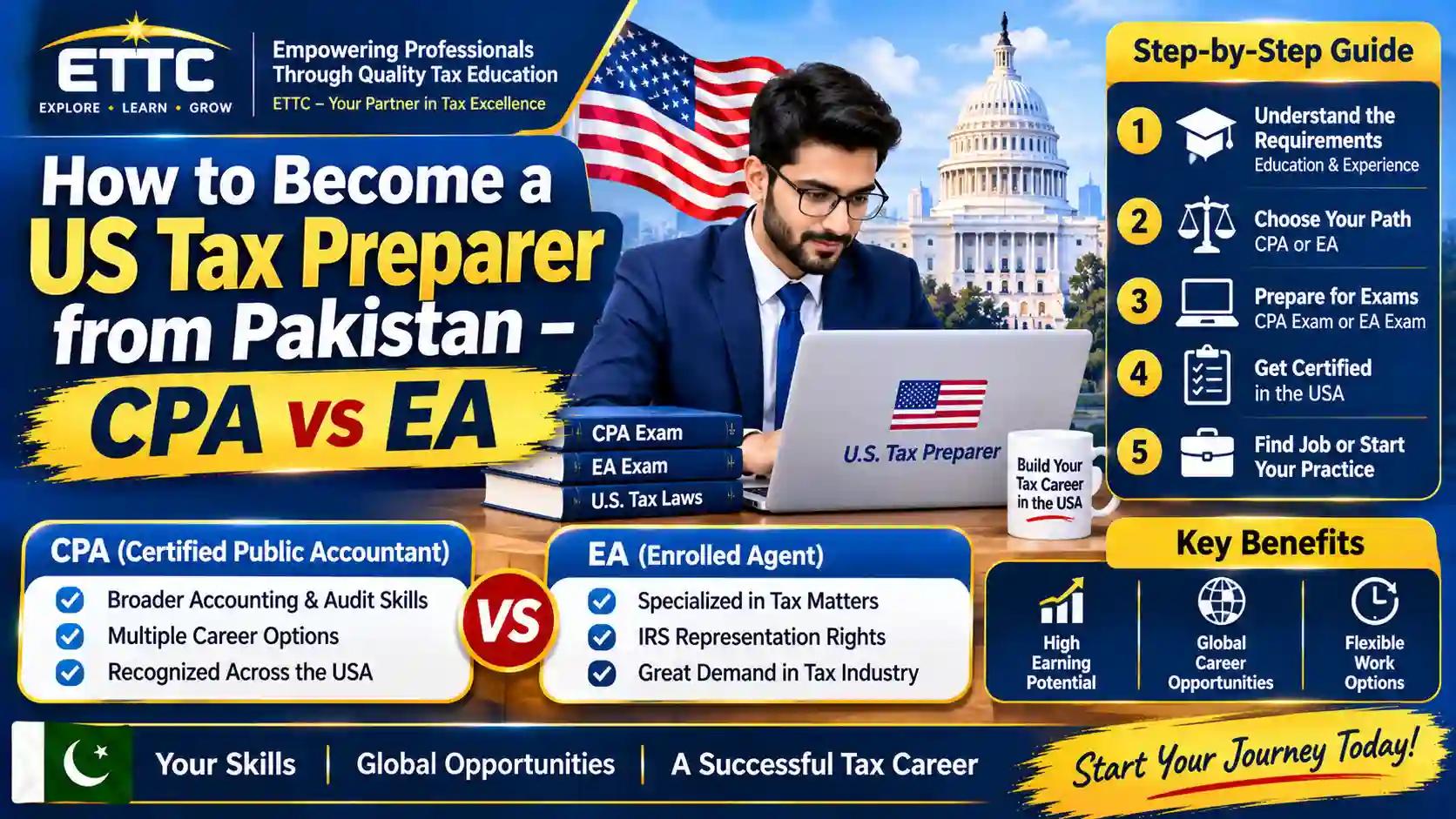
The real question is which route fits you. The Enrolled Agent (EA) path is faster, cheaper and focused only on tax. The US CPA path is longer and costlier, but it opens doors in audit, accounting and finance leadership too.
In this guide, I'll walk you through both routes in plain language. You'll see the costs, timelines, PTIN rules, salary expectations, remote work options and a clear roadmap you can follow.
A US tax preparer from Pakistan can start by getting a PTIN, then choose between the EA credential (three exams, no degree needed, federal tax authority) or the US CPA license (four exams, 150 credit hours, state-based license). Most Pakistani professionals choose the EA first because it is faster and tax-focused.
What Is a US Tax Preparer? (PTIN-Only vs EA vs CPA)
A US tax preparer is anyone who prepares or helps prepare federal tax returns for payment. The United States has three broad levels of preparers:
- PTIN-only preparers. They hold a Preparer Tax Identification Number and can prepare returns. Their right to represent clients before the IRS is very limited.
- Enrolled Agents (EAs). They are federally licensed by the IRS and have unlimited representation rights. They can represent any taxpayer before the IRS on any tax matter.
- Certified Public Accountants (CPAs). They are licensed by a US state board of accountancy. They also have unlimited representation rights, plus authority over audit and attest work.
If you are new to how US taxation is administered, start with our simple explainer on what the IRS is and how the US tax authority works. It gives you the background that makes the rest of this article easier.
Can Pakistanis Become US Tax Preparers?
Yes, they can. Here's why it works.
The IRS doesn't require US citizenship or US residency to sit the EA exam. Anyone with a valid PTIN can take the Special Enrollment Examination (SEE). The IRS describes the requirements on its Enrolled Agents page.
For the CPA route, eligibility depends on the state board you choose. Many boards accept foreign-educated candidates after a credential evaluation. We'll cover that shortly.
Many US accounting firms also outsource return preparation to trained professionals abroad. Pakistan has become a growing hub for this work. If you want to see how the market looks, read our guide to USA taxation course scope and salary in Pakistan.
One important point: working as a remote preparer for a US firm is not the same as running your own US tax practice. Most Pakistani preparers work under a US firm that handles client contracts, e-filing and compliance. I'll explain this in the legal section below.
Why This Career Matters in Pakistan
Let me be honest about why so many people are asking this question.
- Dollar-linked income. US tax work pays in foreign currency, which protects you against rupee instability.
- Seasonal demand. The US filing season runs roughly from January to mid-April, with extension work stretching to October.
- Low entry barrier. The EA route needs no US degree, and you can study from home.
- Remote flexibility. You can work from Islamabad, Lahore, Karachi, Multan or a small town.
If you are weighing this against other international options, our international taxation career roadmap for Pakistan shows how US tax compares with UK, UAE and Saudi tracks.
EA vs CPA: What Is the Real Difference?
Let me explain it the way I would to a friend.
An EA is a tax specialist. The whole credential is built around taxation and IRS representation. If you love tax work, this is the shortest path to a respected US credential.
A CPA is a broader accounting professional. Tax is one part, but you also learn auditing, financial reporting and business analysis. The CPA is a state licence, so rules differ from state to state.
In one line: The EA is a federal tax specialist licence. The CPA is a state-issued accounting licence with a wider scope.
Here's how they compare on the points people ask about most.
Who issues the credential?
- EA: the IRS (federal).
- CPA: a US state board of accountancy.
What does the exam cover?
- EA: three parts, all tax-related.
- CPA: four sections, covering audit, accounting, tax law, and one chosen discipline.
Do you need a degree?
- EA: no degree requirement.
- CPA: yes, with 150 credit hours in most states.
How long does it take?
- EA: often 4 to 8 months of focused study.
- CPA: commonly 12 to 24 months, plus the education and evaluation process.
What can you do?
- EA: prepare returns and represent clients before the IRS.
- CPA: everything an EA can do, plus audit, assurance and broader advisory work.
For a Pakistani professional who wants to start earning from US tax quickly, the EA usually wins on speed and cost. For someone aiming at Big Four-style careers or senior finance roles, the CPA carries more weight.
EA Requirements for Pakistani Candidates
Here is what the IRS expects, and what it means for you.
Step 1: Get a PTIN
You need a Preparer Tax Identification Number before you can register for the EA exam. The IRS explains the process on its PTIN page.
Can non-US citizens get a PTIN? Yes. If you don't have a US Social Security number, you generally apply using Form W-12 by mail instead of the online system. Processing can take several weeks, so apply early. Always check the current IRS instructions for foreign applicants before you submit.
Step 2: Pass the Special Enrollment Examination (SEE)
The EA exam has three parts:
- Part 1: Individuals (Form 1040 preparation, income, deductions, credits)
- Part 2: Businesses (partnerships, corporations, trusts, estates)
- Part 3: Representation, Practices and Procedures (IRS audits, appeals, collections, ethics under Circular 230)
Each part has 100 multiple-choice questions and a time limit of 3.5 hours. The passing score is 105 on a scaled range of 130. You can take the parts in any order, and you must pass all three within a two-year window.
The exam is delivered through Prometric. Check the Prometric locator for the nearest centre to Islamabad, Lahore or Karachi. Test centre availability for international candidates can change, so confirm before you pay.
Step 3: Apply for Enrollment
After passing, you apply to the IRS and go through a suitability check. The application is filed on Form 23. Many people mix this up with Form 8554, which is the renewal form, not the first application. Getting this detail right will save you confusion later.
Step 4: Maintain Your Credential
EAs must complete continuing professional education (CPE). The current rule is 72 hours every three years, with at least 16 hours each year, including 2 hours of ethics.
Good to know: No degree and no work experience are required for the EA exam. This is why the route is so popular with commerce graduates, ACCA students and career switchers.
CPA Requirements for Pakistani Candidates
The US CPA is more complex because each state sets its own rules. Here is the general path.
Step 1: Pick a State Board
Some states are more friendly to foreign-educated candidates than others. Choose based on education rules, residency requirements and licence requirements. NASBA publishes state details on its official website.
Step 2: Get Your Education Evaluated
Your Pakistani degree is evaluated to see how it matches US credit requirements. Most states want 150 semester credit hours, with a set number in accounting and business subjects. A B.Com, M.Com or MBA may or may not cover everything, and you might need extra courses.
Can ACCA holders become US CPAs? Often yes, but not automatically. ACCA and ICAP (CA) qualifications can help with exam subjects, but each state decides what it accepts. An evaluation will tell you the exact gaps.
If you are currently an ACCA or CA student, our guide on taxation courses for CA and ACCA students shows how to build tax skills alongside your qualification.
Step 3: Pass the CPA Exam
Under the current CPA Evolution model, you pass three core sections and one discipline:
- Core: Auditing and Attestation (AUD), Financial Accounting and Reporting (FAR), Regulation (REG)
- Discipline (choose one): Business Analysis and Reporting (BAR), Information Systems and Controls (ISC), or Tax Compliance and Planning (TCP)
For a tax-focused career, TCP is the natural discipline choice. The passing score is 75 on each section. The exam is run by AICPA and administered by NASBA and Prometric. As an international candidate, you may need to sit the exam at an approved overseas centre, so check the current location list before you plan.
Step 4: Meet Experience and Ethics Rules
Most states require work experience verified by a licensed CPA. Some also require an ethics exam. These rules vary, so confirm them with your chosen board.
Cost Comparison in PKR (Honest Estimates)
Costs change with exchange rates and fee updates, so treat these as planning ranges, not quotes.
EA route (approximate):
- PTIN fee: modest, in the tens of US dollars
- Exam fee: around US$200 or more per part, so roughly US$600 to US$700 total
- Review course: from a few hundred to over a thousand US dollars depending on provider
- IRS enrolment fee: a small additional charge
All-in, many candidates budget somewhere between PKR 400,000 and PKR 800,000, depending on the review course and retakes.
CPA route (approximate):
- Credential evaluation and application fees
- Exam fees per section, plus international surcharges
- Review course (Becker, Gleim, Surgent or Roger CPA Review)
- Possible extra university credits
- Travel to an overseas test centre if needed
Many candidates budget PKR 1,500,000 or more in total, and sometimes much higher if extra coursework is needed.
Reality check: The cheapest route isn't always the best, but for most Pakistani candidates the EA gives a faster return on investment. Always confirm the latest fees on the IRS, NASBA and Prometric websites.
How Long Does It Take: EA vs CPA?
EA: If you study 10 to 15 hours a week, many people finish all three parts in 4 to 8 months. Add a few weeks for PTIN processing and IRS enrolment.
CPA: Plan for 12 to 24 months for the exams alone, plus time for credential evaluation, extra credits (if needed) and experience requirements. Many states now give a longer window to pass all four sections, but check your board's current rule.
Salary and Job Scope in Pakistan
Let me be careful here. Salaries vary by employer, season and your experience, so these are rough market indications only.
- Freshers and junior preparers: often around PKR 60,000 to 120,000 per month
- Experienced preparers and reviewers: often PKR 150,000 to 300,000 or more
- EAs and CPAs with strong client handling: can go well beyond that, especially with freelance or contract income in dollars
Which pays more, CPA or EA? In general, CPAs can earn more over a long career, mainly because they can move into audit, controllership and executive roles. But for pure tax work, a skilled EA can match or beat many CPAs, especially in freelance or niche practice.
Jobs you can target after getting your credential include:
- US tax preparer or reviewer at an outsourcing firm
- Remote tax associate for a US CPA firm
- US expat tax specialist
- Bookkeeper and tax preparer for small US businesses
- Freelance tax consultant
If you want a wider view of working for foreign clients, read our guide to tax consultant jobs abroad for Pakistanis.
Can I Legally Prepare US Tax Returns from Pakistan?
Yes, but there are rules you should know.
- PTIN: Any paid preparer of US federal returns needs one.
- E-filing: Filing electronically needs an Electronic Filing Identification Number (EFIN). This is usually held by the US firm you work with, not by you personally.
- Client consent: US law (Section 7216) is strict about sharing taxpayer data. If a US firm sends client data to an overseas preparer, the firm normally needs the client's written consent.
- Software: Most firms use tools like Drake, TaxAct, UltraTax, Lacerte or ProSeries.
- Pakistani tax: Your own earnings from US work are taxable income in Pakistan. Our guide on freelancer tax in Pakistan explains how to stay compliant with FBR.
This is general information, not legal advice. For your own situation, speak to a qualified professional.
Which Is Better: EA or CPA? A Simple Decision Guide
Skip the debate and ask yourself three questions.
Do you want to specialise in tax only?
Choose the EA.
Do you want audit, finance leadership or a Big Four-style career?
Choose the CPA.
Do you need results quickly and have a limited budget?
Start with the EA.
Can I do both EA and CPA? Yes, and many professionals do. A common plan is EA first for fast income, then CPA later for long-term growth. The tax knowledge from the EA exams also helps with the CPA's REG section.
Step-by-Step Roadmap for Beginners
Here's a simple plan you can follow.
- Learn the basics. Understand how US tax works: filing statuses, income types, deductions and forms.
- Apply for your PTIN. Start early because paper applications take time.
- Choose your path. EA first, CPA first, or both over time.
- Join a structured course. Live guidance and practice save months of confusion.
- Book and pass the exams. Take one part at a time and keep momentum.
- Gain practical experience. Practise on real-style returns and software.
- Apply for enrolment or licensure. Complete the IRS or state board steps.
- Start earning. Apply to outsourcing firms, build a freelance profile, or join a US firm remotely.
If you plan to build your own practice later, our guide on how to start a tax consultancy firm in Pakistan will help. And if you're still deciding on the broader field, see how to become a tax consultant in Pakistan.
Best Cities and Study Options: Islamabad, Lahore, Karachi, Multan and More
Good news: you don't have to live in a major city to qualify. Still, location matters for classroom learning, networking and job access.
Islamabad and Rawalpindi. The twin cities have a strong outsourcing and freelance ecosystem. You can join the USA tax training in Islamabad programme, and our guide on ETTC tax training in Islamabad shows what to expect.
Lahore. A large pool of accounting graduates and US-facing firms makes Lahore competitive and busy. See the USA tax training in Lahore page.
Karachi. As the financial capital, Karachi has many accounting firms and BPO-style employers. Explore the USA tax training in Karachi programme.
Multan, Faisalabad, Peshawar, Sialkot and other cities. No campus is needed here. Online learning works well, and students from these cities join live online batches and work remotely. Our comparison of online vs physical tax courses in Pakistan can help you pick the format that suits you.
Why Choose ETTC?
If you want guidance from people who work in this field, here is why many students choose Elite Tax Training Center (ETTC):
- Practical focus. Training is built around real-world tax work, not just theory.
- Experienced mentors. You can meet the ETTC mentors and see their backgrounds before you enrol.
- Multiple formats. City-based and online options let you study where you live.
- Wider tax pathway. You can combine US tax with other tracks such as international tax planning or the UK, UAE and Saudi tax courses.
- Career support mindset. The goal is employability, not just a certificate.
You can also read why people call ETTC one of the best tax institutes in Islamabad.
Explore Advanced Taxation Courses at Elite Tax Training Center (ETTC): See the full list on the courses page, or go straight to the USA tax course.
Remote Work and Freelancing Options
Once you have the skills, you can earn in several ways.
- Outsourcing firms. They hire preparers and reviewers in bulk during the season.
- Direct remote roles. Some US CPA firms hire Pakistani preparers on contract.
- Freelance platforms. Platforms like Upwork list US tax and bookkeeping gigs. Start with simple 1040 returns and build reviews.
- Expat tax. US citizens living in Pakistan often need help with filing. Our US expat tax return guide for Pakistan covers this niche.
- Bookkeeping plus tax bundle. Adding QuickBooks skills makes you more valuable to small business clients.
Practical tips:
- Build one clear niche, such as individuals, small business or expats.
- Keep your CPE and ethics knowledge current.
- Use secure, encrypted tools for client data.
- Collect testimonials early.
How to Learn: Free and Paid Resources
You don't have to spend money on everything at once. A smart mix works best.
Free resources:
- The IRS website, including Publication 17 for individual taxpayers
- IRS Circular 230 for practice rules
- Free sample questions from review providers
- Our blog guides on direct vs indirect tax for core concepts
Paid resources:
- Review courses from providers like Gleim, Surgent or Becker
- Instructor-led training with live practice
- Tax software practice licences
My honest advice is to use free material to learn the basics, then pay for structure when you reach exam preparation. Mentor feedback saves far more time than extra videos.
Real-World Examples
Example 1: The ACCA student. Ayesha, an ACCA student in Lahore, wants quick dollar income. She gets a PTIN, studies for the EA over six months and joins an outsourcing firm as a junior preparer. Within a year she is reviewing returns.
Example 2: The CA graduate. Hamza, a chartered accountant from Karachi, wants long-term growth. He starts with the EA for quick income, then works toward the CPA with the TCP discipline while earning.
Example 3: The commerce graduate from Multan. Bilal has a B.Com and no big-city access. He studies online, passes the EA, and builds a freelance practice around US expats and small businesses.
These are illustrative scenarios, not guarantees. Your results depend on effort, skills and the market.
Future Career Opportunities
Where can this go in five years? Here are a few paths:
- Senior reviewer or team lead at an outsourcing firm
- Tax manager at a US-facing practice
- Independent EA with your own client base
- International tax specialist, combining US, UK and UAE knowledge
- CPA with TCP, moving into advisory or finance leadership
Advanced skills in international tax planning strategies can lift your value even further, especially for cross-border clients.
Frequently Asked Questions
Can a Pakistani become an enrolled agent?
Yes. The IRS doesn't require US citizenship or residency to take the EA exam. You need a PTIN, you must pass all three parts of the SEE, and you must complete the IRS enrolment process.
Do I need to live in the US to become an EA?
No. You can study and prepare from Pakistan. You only need to confirm test centre availability and follow the IRS steps for foreign applicants.
Can I prepare US tax returns from Pakistan?
Yes, usually by working with or for a US firm. You need a PTIN, and the US firm typically handles e-filing and client consent for data sharing.
Which is better, EA or CPA?
It depends on your goal. The EA is faster, cheaper and tax-focused. The CPA is broader, takes longer and suits audit and finance careers.
Is the EA exam hard?
It is challenging but very achievable with structured study. Part 3 (Representation) is often considered more manageable, while Parts 1 and 2 need steady practice with forms and rules.
How long does it take to become an EA from Pakistan?
Many candidates complete it in 4 to 8 months of consistent study, plus processing time for the PTIN and IRS enrolment.
Can ACCA holders become US CPAs?
Often yes, but each state board decides what it accepts. A credential evaluation will show exactly which subjects or credits you still need.
Can I do both EA and CPA?
Yes. Many professionals start with the EA for faster income and add the CPA later.
Conclusion: Your Next Step
You can build a respected US tax career from Pakistan, and you don't have to figure it out alone.
If speed and tax focus matter most, start with the EA. If you want a broader accounting career, plan for the CPA, and consider doing both over time. Either way, the first move is the same: learn the fundamentals, get your PTIN and commit to a clear study plan.
Ready to take the next step? Book a seat at the Advanced Taxation Course offered by ETTC, the best tax training institute for building a practical, job-ready skill set. You can also contact the ETTC team with questions, or start with the USA tax course today.
Written by
ETTC Team
Expert instructor at ETTC – Elite Tax Training Centre, helping professionals master practical taxation for global careers.